The Reliability Fix No One Talks About.
If your team hesitates to commit or keeps missing deadlines, the problem isn't effort — it's orientation.
What a Team of Financial Wizards Taught Me About Commitment
I've hiked 3,500 miles of America's national scenic trails. I've paddled 2,100 miles down the Mississippi River. I've crewed my husband through a 65-mile non-stop open water swim that broke a Guinness World Record.
I know what it looks like when someone decides they're not stopping.
And I know what it looks like when someone is still negotiating with themselves about whether they will.
That gap — between intending to do something and actually doing it — is where I've spent the last 20 years of my career. In boardrooms and in backcountry. With founders building their first teams and executives running billion-dollar brands.
Last month, I brought that lesson off the trail and into one of the most unusual leadership events I've ever designed.
"Reliability isn't about if. It's about how."
The Team that Walked 501-Miles
Jeff Socha is a founder and one of my most adventurous clients. When I pitched him an overnight endurance challenge for his entire team, he said yes without flinching.
That's how 27 people — a founder and his team of financial planners, with zero endurance training between them — ended up walking laps in the dark from 8PM to 8AM.
My husband, a Guinness World Record athlete, co-hosted. Not as a fitness coach. As someone who has personally lived the question every walker faced that night: when your body wants to stop, what makes you keep going?
Here's what happened:
Ten people chose to stay up all night. Two of them logged nearly 34 miles each. Six others finished a full marathon. The rest put in 15–20 miles on exhausted legs, without sleep…wearing costumes.
501 miles. Together.
These weren’t athletes. They were people who showed up, made decisions as a team, and did what they said they would do — lap after lap.
"Before we started, they didn't think it was possible. They proved themselves wrong."
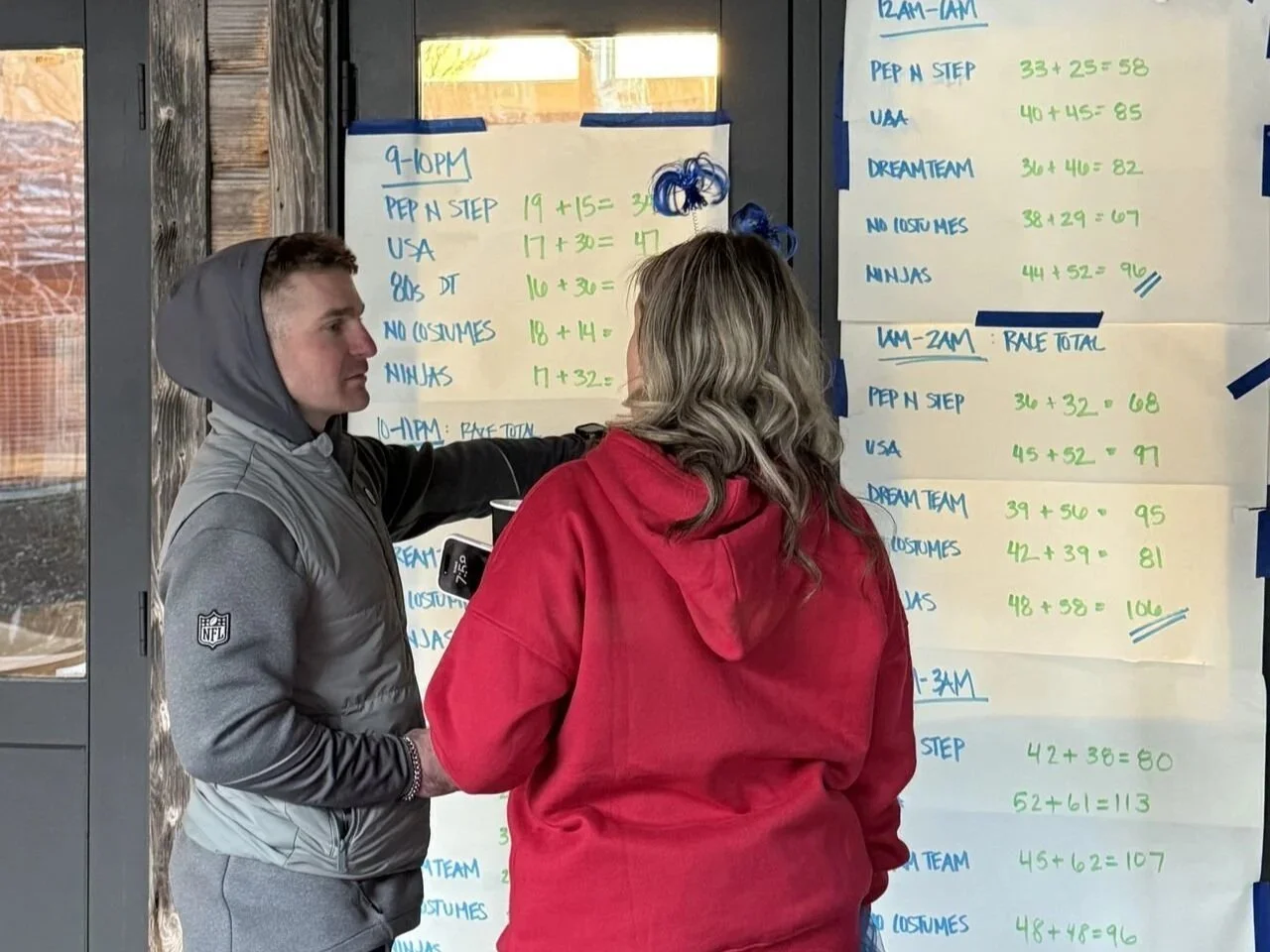
Reviewing the leader board.
The One Idea That Changed Everything
Across the workshop and the challenge, one idea surfaced again and again: There's a word that quietly kills execution in organizations. It's not no. It's try.
"I'll try to get that done." "We'll try to hit that number." "Let's see if we can make it work."
Try sounds reasonable. It sounds humble. But embedded in it is an escape hatch — a pre-negotiated exit from commitment. The world of if gives people permission to quit before they've started.
The teams that performed best that night weren't the strongest. They were the ones who stopped asking if they'd keep going and started solving how they would.
That shift is everything.
If keeps you in the problem. How moves you toward the solution. If is still deciding. How has already committed and is figuring out the path.
Zoe and Mark—the two walkers who logged the most distance—didn't cover 34 miles because they were trained for it or build differently. They did it because at some point, they stopped entertaining the question of whether and started answering the question of how.
In the team recap, Zoe said: “I started running the numbers in my head and I realized, we could walk a marathon. Then, after a few hours, I realized, wow, we could walk even farther.”
That's not a personality trait. It's a learnable orientation. And it transfers directly from a walking loop at midnight to a quarterly target on a whiteboard.
"When you're operating in the world of 'if,' you're still negotiating with yourself."
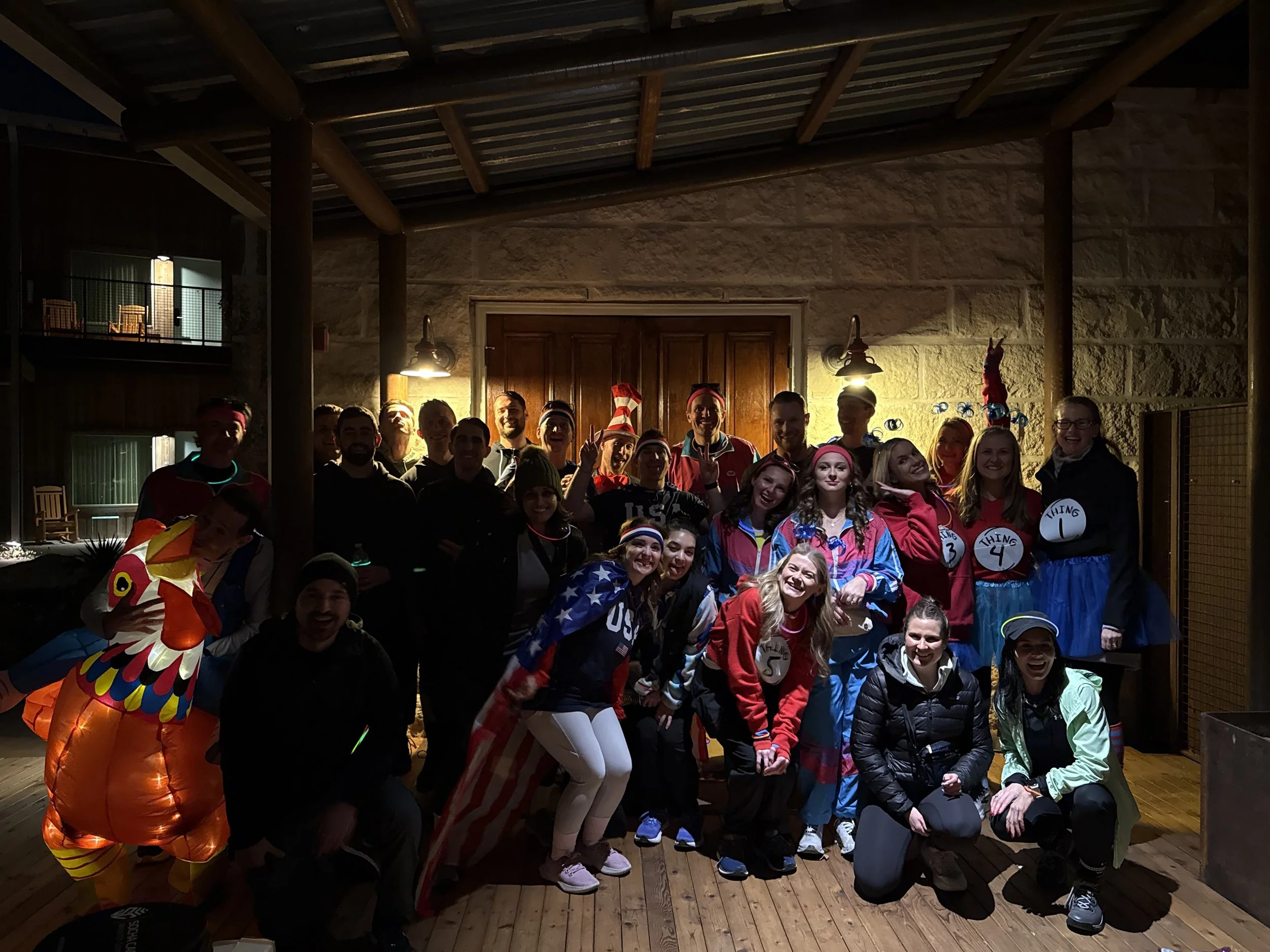
The team that walked 501-miles, overnight, in costumes!
Effort vs. Orientation
The issue for teams struggling with reliability usually isn't effort or intention. It's orientation.
Here's where to start:
Audit the language in your next team meeting. Count how many times you hear "I'll try," "we should," or "hopefully." These aren't innocent filler words — they're signals that your team is still in if-land. When you hear them, don't let them pass. Ask: "What would it sound like if that were a commitment?"
Replace outcome-framing with process-framing. "If we hit the target" keeps the result in question. "Here's how we're going to hit the target" assumes it and gets to work. The reframe is small. The behavioral difference compounds fast. Train your team to lead with the path, not the possibility.
Create conditions where people surprise themselves. Jeff's team didn't walk 500 miles because they trained for it. They did it because they committed to something uncomfortable, in front of each other, with no graceful exit. There's a version of this in every organization. Accountability isn't a system you install. It's a culture built one kept promise at a time — and it starts when people discover what they're actually capable of.
“Your team's reliability limit is set by the language they use when things get hard."
What I Know from the Miles
At 8AM, when the last walkers finished, something had shifted. Not just physically. Something in how they saw themselves. They had done something they didn't think was possible. They didn't just complete the challenge — they expanded their own ceiling.
That's what real leadership development looks like. Not a slide deck. Not a framework you forget by Thursday. An experience that rewrites what someone believes they're capable of.
If your team is stuck in the world of if — the path forward isn't a pep talk. It's a commitment.
Start there.
This post is part of an ongoing series on leadership, resilience, and what the wilderness teaches us about building great organizations.