
Stop Paddling. Start Navigating.
What 2,100 miles on the Mississippi River taught me about developing the leaders around you.

Paddles Up
There's a moment somewhere around day thirty on the Mississippi River when paddling harder stops making sense.
Especially when you're paddling in the dark.
People say that if a drop of rain falls into the headwaters, it takes about 90 days to reach the Gulf. As it turns out, it's about the same for a two-person canoe. In 2022, my husband and I paddled from the headwaters of the Mississippi at Lake Itasca, Minnesota to the bayous of Louisiana — more than 2,100 miles.
We paddled through rain and into headwinds. We hauled our canoe over beaver dams in the Minnesota wilderness and locked through 27 dams as the Army Corps of Engineers moved millions of gallons of water on our behalf. As we made our way south and the river opened wide, we encountered an entirely different kind of obstacle: the heat.
In an attempt to outsmart a brutal heatwave, we started paddling at night. Our routine was simple: wake at 2AM, break camp in the dark, and push off into the river under a cool, waning moon. It was quiet. Our paddles dipped gently in and out of the water as the current curled around us — and barges half the length of a football field powered past us in the blackness.
A paper nautical chart isn’t very useful at night. So, we used high powered head lamps to locate the channel buoys and the lapping edges of the river, re-orienting every 100 yards until dawn.
Somewhere out there on the water, in the silence, it became clear: the skills that got you this far — sheer effort, relentless forward motion — are no longer the skills that will get you to the Gulf. What's required now is something harder, and quieter. Thinking strategically about the 24-hours in each day. Reading the river. Trusting it. Navigating instead of just paddling.
"The skills that got you this far — sheer effort, relentless forward motion — are no longer the skills that will get you to the Gulf."
The Big Lesson from the Big Muddy
The river is never the same twice. Buoys drift. Currents change without warning. What worked upstream is irrelevant downstream—it’s an entirely different river south of St. Louis. And the further south you go, the more you realize that the paddlers who struggle most aren't the weakest ones — they're the ones who keep applying force when what the moment demands is patience and perception.
We learned to read the river. To study it. To stop fighting conditions we couldn't control and start using them to our advantage.
The most important thing I took away from 2,100 miles on the Mississippi had nothing to do with paddling technique. It had everything to do with control — and when to let go of it.
Most founders never have that A-HA moment. And it costs them everything.
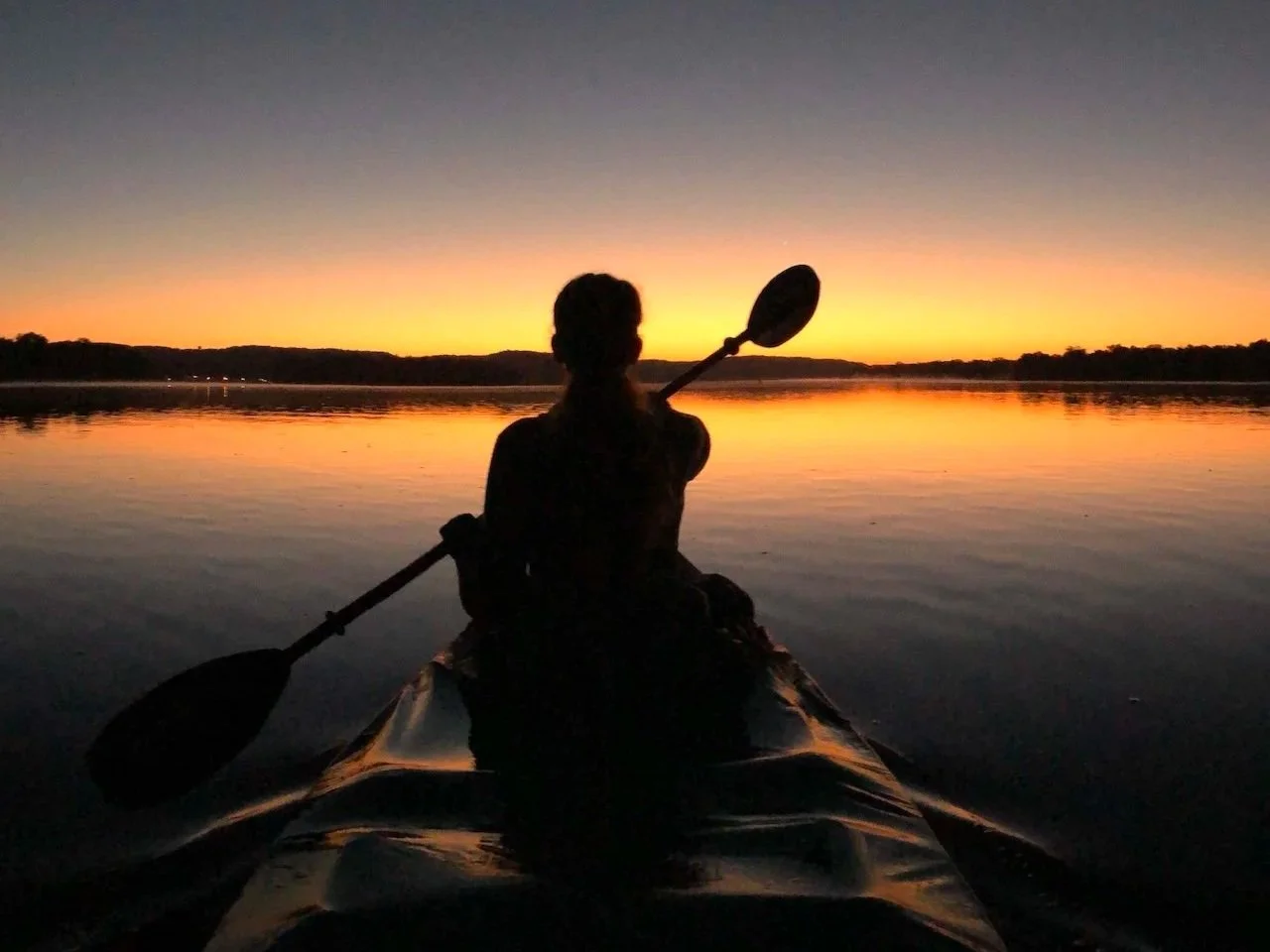
That’s me, at the break of dawn, after hours of night paddling on the Mississippi River.
The Founder & CEO’s Trap
Most founders build their companies the same way they build their paddling stroke: by being the best, most capable person in the boat. They outwork, out-think, and out-execute everyone around them. It works — until it doesn't.
At some point, the business grows faster than one person can carry it. The team expands. The decisions multiply. And the founder — still paddling as hard as they ever did — becomes the very thing slowing everyone down.
This is the trap that no one likes to talk about. Not a market problem. Not a product problem. Not even a talent problem.
The problem is you.
The skills that made you exceptional in the early days — the speed, the instinct, the ability to just handle it — are the same skills that prevent your team from developing their own. Every time you paddle when you should be navigating, you rob someone else of the chance to learn how to row.
"Every time you paddle when you should be navigating, you rob someone else of the chance to learn how to row."
The Hardest Transition in Leadership
Moving from paddler to navigator is the most uncomfortable transition a Founder or CEO will ever make. And it should be — because it requires trading the thing you're best at (doing) for something that feels far less certain (trusting others to do).
The tension is real. Developing leaders takes time you don't feel you have. Trusting people who aren't ready feels reckless. Letting go of control feels like risking everything you've built. It feels a lot like paddling in the dark.
But here's what the river taught me: the current is going to keep moving whether you're navigating or just paddling in circles. The question isn't whether your team will grow into bigger roles. The question is whether you'll invest in them before you need them — or after it's too late.
What Navigators Do That Paddlers Don't
Making the shift from paddler to navigator isn't abstract — it's behavioral. Here are three places to start:
1. Stop doing everything. Start teaching everyone.
Every task you complete alone is a teaching moment you spent on yourself. Navigators don't just solve problems — they solve problems out loud, alongside their people, so that the next time, someone else can lead. Your job is no longer to have the answers. It's to develop the people who will find them.
2. Stop waiting for perfect. Start betting on potential.
The moment you're waiting for — when a team member is fully ready, fully proven, fully safe to trust with a bigger role — will never come. Navigators make bets on people before the outcome is certain. That discomfort is the investment. The leaders on your team will only grow as large as the roles you're willing to give them.
3. Stop finding time to develop people. Start protecting it.
Mentorship doesn't happen in the margins of a founder's calendar. It gets cancelled, deferred, and deprioritized — not because founders don't care, but because everything feels more urgent. Navigators treat time with their developing leaders as non-negotiable. Block it. Guard it. Treat it as the highest-leverage activity on your calendar, because it is.
"The problem compounds — quietly, invisibly — until one day the organization can't move without you."
The Cost of Staying in the Boat
Here's the math most founders don't want to do.
Every decision you make alone is a decision someone on your team didn't get to make. Every problem you solve yourself is a problem no one learned to solve without you. Every role you hold onto too long is a role someone else stopped growing toward.
It compounds — quietly, invisibly — until one day the organization can't move without you. And by then, the most talented people on your team have already started looking for a boat where they're trusted to row.
This isn't a talent problem. It isn't a hiring problem. It's a navigation problem.
One Question
Before your next leadership meeting, look around the table. For each person sitting there, ask yourself one question: Am I developing this person, or am I just directing them?
Directing keeps the boat moving today. Developing is what gets you to the Gulf.
The river is long. The current is moving. And you cannot paddle every mile of it alone.
This post is part of an ongoing series on leadership, resilience, and what the wilderness teaches us about building great organizations.
